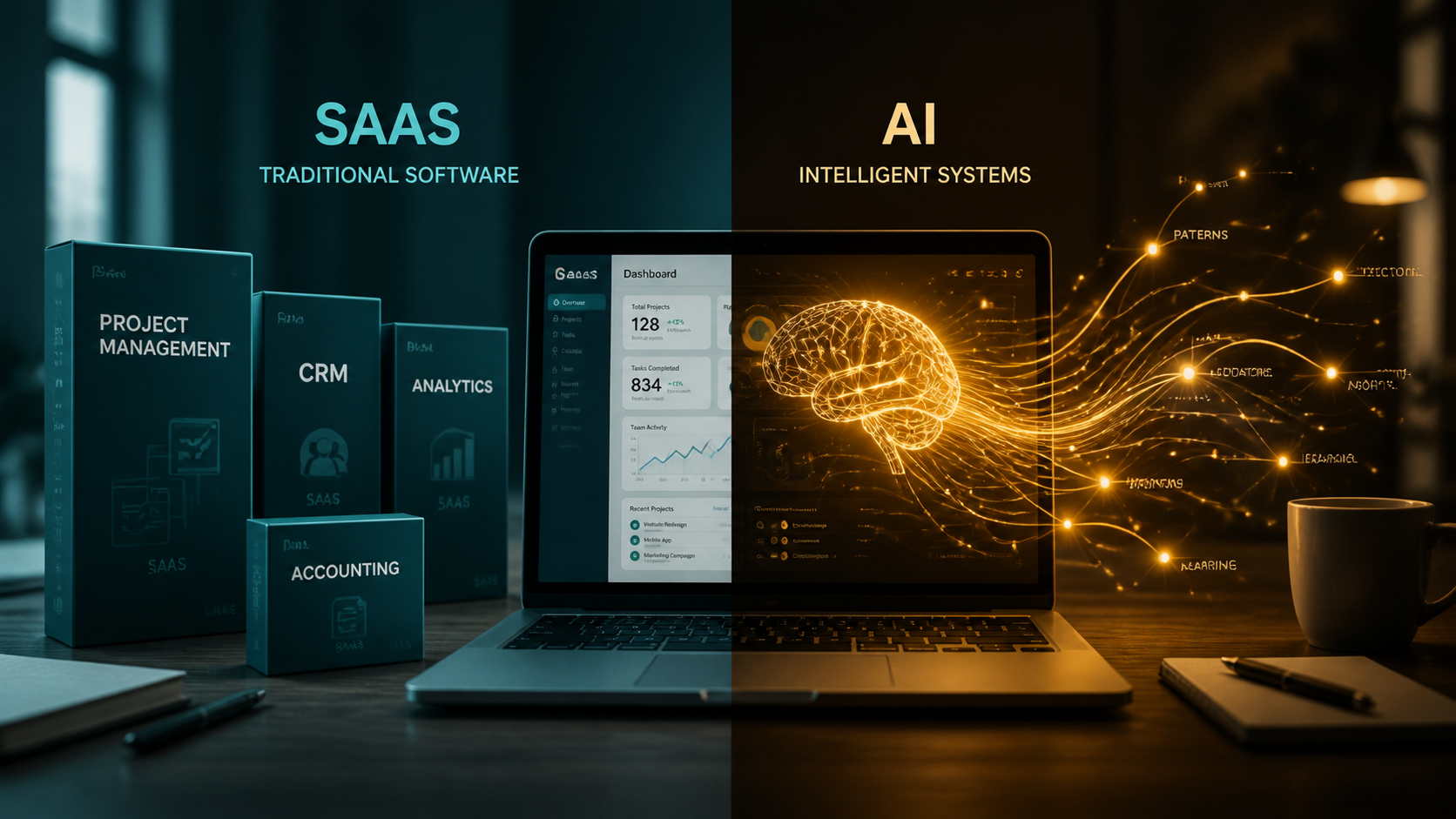
The Two Worlds
Traditional SaaS is software you operate: you fill in fields, click buttons, and manage data. AI-native tools are software that works for you: you describe a goal, and it does the work. Both coexist in 2026, but the balance is shifting fast.
| Dimension | Traditional SaaS | AI-Native Tools |
|---|---|---|
| User role | You operate the software | You direct the software |
| Input | Data entry, manual setup | Natural language prompts |
| Output | Dashboards, records | Finished work (drafts, code, images) |
| Learning curve | Steep (features, settings) | Low (describe what you want) |
| Pricing | Per seat, per month | Usage-based, credits |
| Example | Salesforce, Monday.com | Cursor, Lovable, ChatGPT |
What's Actually Happening
1. AI Is Being Added to Everything
Every traditional SaaS tool now has an "AI assistant." HubSpot has AI copywriting, Salesforce has Einstein, Notion has Notion AI. The question is whether these are genuine improvements or checkbox features. In our testing, some add real value (Notion AI, Cursor) while others feel bolted on.
2. AI-Native Tools Are Eating the Middle
For many tasks, you no longer need dedicated software. Why buy a writing tool when Claude writes better? Why buy a basic app builder when Lovable generates one? AI-native tools are replacing generic SaaS for common tasks, while specialized SaaS (CRM, payroll, compliance) remains essential.
3. The New Winners Combine Both
The strongest tools in 2026 are hybrids: AI-first but built on solid SaaS foundations. Cursor is AI + IDE. Clay is AI enrichment + database. HubSpot is AI + CRM. The tools that win layer intelligence on reliable infrastructure.
What This Means for Buyers
When to Choose SaaS
- You need structured data and reporting (CRM, analytics)
- Compliance, security, or governance matter (payroll, legal)
- Your team relies on established workflows and integrations
When to Choose AI-Native
- You're producing content, code, images, or research
- You need speed over process
- You're a small team that can't justify heavy SaaS stacks
When to Choose Hybrid
- You need both structure and intelligence
- Your core tool has genuinely useful AI built in
- You want one platform instead of five disconnected tools
What's Next (2026-2027)
- Agentic software: Tools that don't just assist but complete entire workflows autonomously
- AI-first pricing: Shift from per-seat to per-outcome pricing
- Consolidation: Expect acquisition and merging of AI-native tools into bigger platforms
- Data advantage: The tools with the best proprietary data will pull ahead
We test both worlds. Browse our AI tool reviews and SaaS reviews to see which tools from each category are actually worth using.